Why a Found Opinion Beats Any Ad
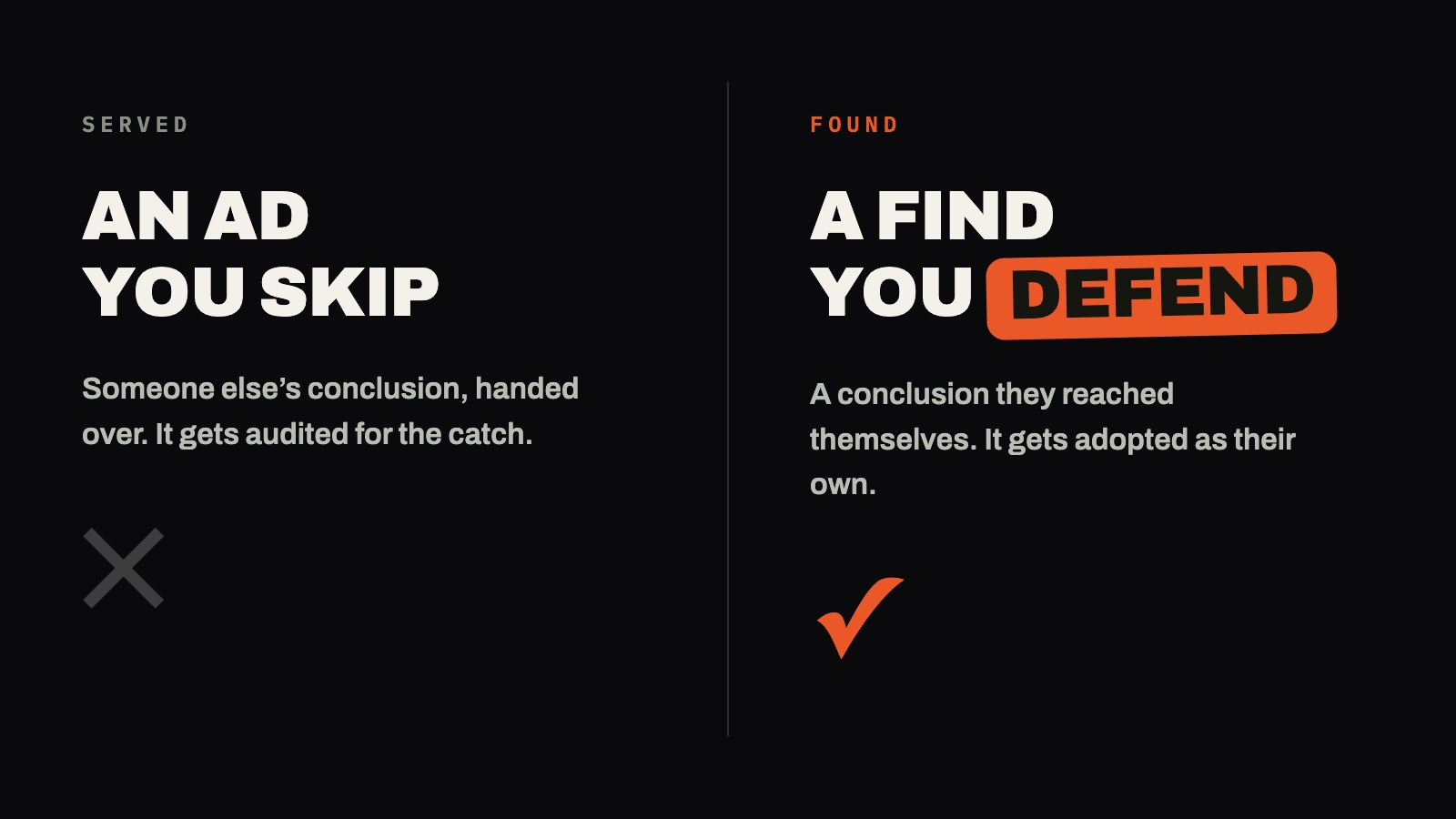
A found opinion is a conclusion a person reaches on their own: a stranger's take they scrolled past, a product they noticed three times in one week and finally looked up. People defend found opinions the way they never defend ads, because a found opinion feels like their own thinking. An ad gets audited. A find gets adopted.
Where we stand should be on the table before the argument starts. Manyloud builds campaigns on exactly this principle, with AI creators posting product videos into the feed people already scroll. So this is not a neutral essay. It is the idea our company runs on, written down.
Why don't people trust ads anymore?
People distrust ads because an ad announces its intent: the viewer knows somebody paid for the encounter, and they discount everything in it. TikTok's own research, the Community and Self-Expression study, found that 59% of users feel polished brand ads are out of place in their feed, and the same research measures creator-style videos driving about 33% stronger consideration than produced ones.
The deeper mechanism is about who owns the conclusion. A message you are handed is someone else's conclusion, so you check it for the catch. A video you happen to find is raw material, and whatever you decide after watching it is yours. People argue with ads. People argue for their own conclusions.
Every good salesperson has known this forever: the customer who talks themselves into the product stays sold. The feed runs that conversation at scale, one short video at a time.
Why does seeing a product everywhere make you want it?
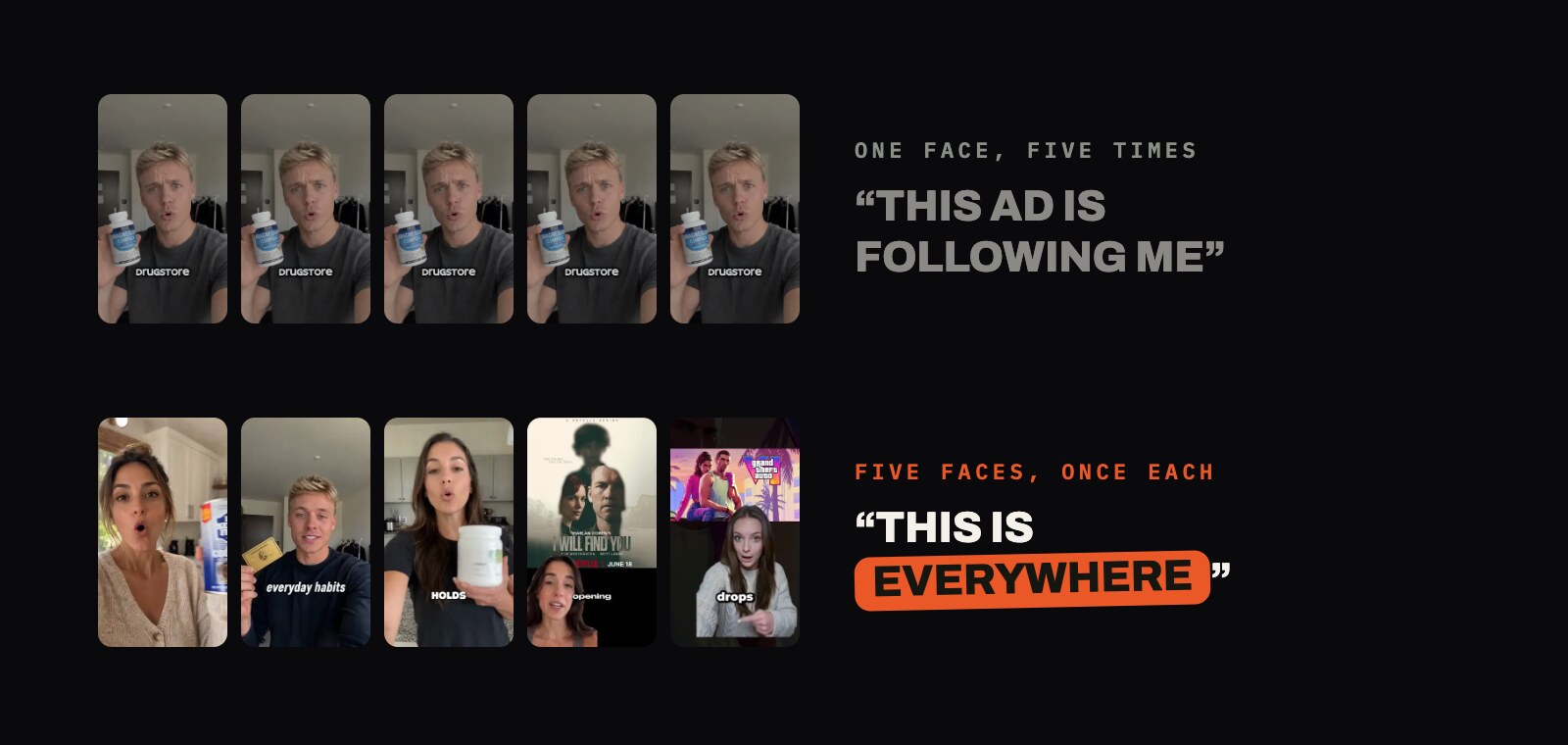
Seeing a product everywhere works because it stops reading as advertising and starts reading as the world changing. Frequency has been advertising's main lever for a century, and the feed quietly changed what frequency feels like: five faces are not one face five times.
See the same face pitch the same product five times and the conclusion is instant: this ad is following me. Irritation compounds with every repeat. Now spread the same five exposures across five unrelated people in one week and the meaning flips: this is everywhere. The count never changed. The apparent independence of the sources did.
That flip is what carried Stanley from $73M in revenue to a projected $750M in four years, per CNBC's reporting: thousands of unrelated posts made owning the cup look like a fact about the world, and the teardown walks through how.
In a feed, the unit of trust is the number of separate voices carrying the message. One voice, however big, is a channel. Many small ones are a signal.
Why do perfect reviews feel fake?
Perfect reviews feel fake because everyone has met the scam behind a flawless rating wall. A page of nothing except five stars sends buyers hunting for the catch. A review that names a drawback lands as complete: this person actually used the thing, hit its limits, and recommends it anyway. The same instinct runs offline, where nobody trusts the salesperson for whom every product in the store is wonderful. Trust needs one visible flaw to hold on to, and the flaw is the credential. We wrote a whole piece on this paradox: the authenticity of a video was never about who made it, it is about whether it behaves like persuasion.
Disagreement does the same work in comments. When people argue under a video about whether a product deserves the hype, the argument itself proves the product is real enough to argue about. A unanimous chorus closes the conversation. A skeptic keeps it open, and everyone in the thread spends another minute with the product while the platform counts that conversation as interest and shows the video to more people.
We build this deliberately. In our campaigns some creators play the skeptic on camera, unconvinced until the product earns it, because a feed that only cheers looks bought. A feed that argues looks alive.
Do people actually buy from TikTok?
People do buy from TikTok, the habit is documented, and the sources are public. In an Adweek and Morning Consult survey, 49% of TikTok users had bought something they first saw there. In EMARKETER's social commerce survey from April 2026, 70% of social shoppers said they had bought on TikTok in the past year, more than on any other platform.
None of this kills advertising. People simply buy where nothing seems to be selling to them. The purchase follows the find, and the find only happens in a feed worth scrolling.
Can word of mouth be engineered?
Word of mouth has always been engineered. Launch lines, limited drops, seeded samples, press embargoes: brands have manufactured "organic" moments for as long as there have been launches. The feed just changed the arithmetic: a moment that once took a store line or a stadium now takes a few hundred short videos landing in the right feeds in the same week, and every one of them can be counted, compared and repeated. Engineering word of mouth stopped being an art project and became a production schedule.
Our version is a thousand AI creators posting reviews, comparisons and how-tos into the feed where a product's buyers already scroll. Nothing is pushed at anyone. The people who care run into the videos, watch a few from different faces, and look the product up themselves.
Is this just astroturfing?
A fair question to ask a company that just told you it engineers word of mouth. Astroturfing is fake grassroots: hidden sponsorship, invented customers, denial when caught. What we make is advertising built for how people actually watch. The people on screen are actors, the way ads have used actors for seventy years, and ours happen to be AI. Videos carry labels where a market requires them. Scripts stay in opinion and explanation territory, and every word is approved by the client before anything posts, so nothing goes out that the client cannot stand behind. The format is new. The rules underneath it are the ones advertising has always had.
To them it is not an ad. It is their find.
If you want the practical side of this idea, the full cost breakdown of AI UGC is public, and so is our pricing. Or tell us what you are launching, and we will show what a found campaign looks like for your product.
The pricing is public, the first campaign starts at $5,000, and scripts take hours.

