AI UGC: What It Is and What It Costs in 2026
AI UGC is creator-style advertising where the person on screen is AI-generated. The video looks like something a regular customer filmed on their phone: a face talking to the camera, a product in hand, a kitchen or a car in the background. The face and the voice are made. So is the script. The format is borrowed from real life, because real life is what people watch.
This guide covers what AI UGC is and what it costs in 2026, from a $20 tool to a 50,000-video campaign. And how to tell which price you should be paying. We run one of the largest AI UGC operations on TikTok, so read the agency parts knowing where we stand. The numbers we quote for our own service are our real, public prices.
What is AI UGC?
AI UGC is the same creator-style video you see from real customers, except the creator is generated. A designed face says a script you approved, in a setting that matches the message. Nothing about it was filmed by a customer, and everything about it is built to watch like it was.
UGC stands for user-generated content: the reviews, hauls, and "I tried this for a week" videos that regular people post about products. Brands started paying creators to make videos in that style because it outperforms produced ads. That paid version kept the name UGC, even though a marketer ordered it. AI UGC is the next step in that line.
One important line to draw. "AI UGC" does not mean a human creator who edits with AI tools. It means the presenter does not exist. Different companies name this differently: Arcads says AI actors, HeyGen and Synthesia say AI avatars, TikTok's own ad product calls them digital avatars. The video format they all produce is the same.
The point of AI UGC was never to fool anyone. It is a way to make a thousand real product videos without booking a thousand people.
Why are brands switching to AI UGC?
The short answer is that polished ads stopped earning attention and human creators do not scale.
TikTok's own research with PA Consulting found that 76% of users say real people in finance content make a brand feel relatable, and 71% want a candid tone. TikTok's creator research also measures creator content earning twice the six-second view-through of brand ads. And this is the platform selling those polished ads, which makes it the most honest data point in advertising.
People do buy this way. In an Adweek and Morning Consult survey, 49% of TikTok users said they had bought something they first saw on TikTok.
Human creators can make videos in that style, and good ones are worth it. The problems start at volume:
- Booking 50 creators means 50 negotiations, 50 shipping addresses, 50 deadlines and 50 opinions about your script.
- Reshoots take days. Trends last hours.
- Every creator adds their own wording. In finance, health or crypto, one improvised sentence can be a compliance incident.
AI UGC removes the logistics. Scripts become videos in hours, every word is the word you approved, and volume is a number you choose instead of a recruiting project.
What does AI UGC cost in 2026?
AI UGC costs between $1 and $500 per video in 2026, depending on how you buy it. DIY generator tools run $20 to $200 a month and you do everything yourself. A single human UGC creator charges $150 to $500 per video, around $200 at the published median, usage rights extra. A full-service network like ours delivers at $1 to $3 per video with distribution included: $15,000 buys 5,000 videos posted across 1,250 TikTok accounts. Here is the full price map, from cheapest to most expensive, with what you get at each level.
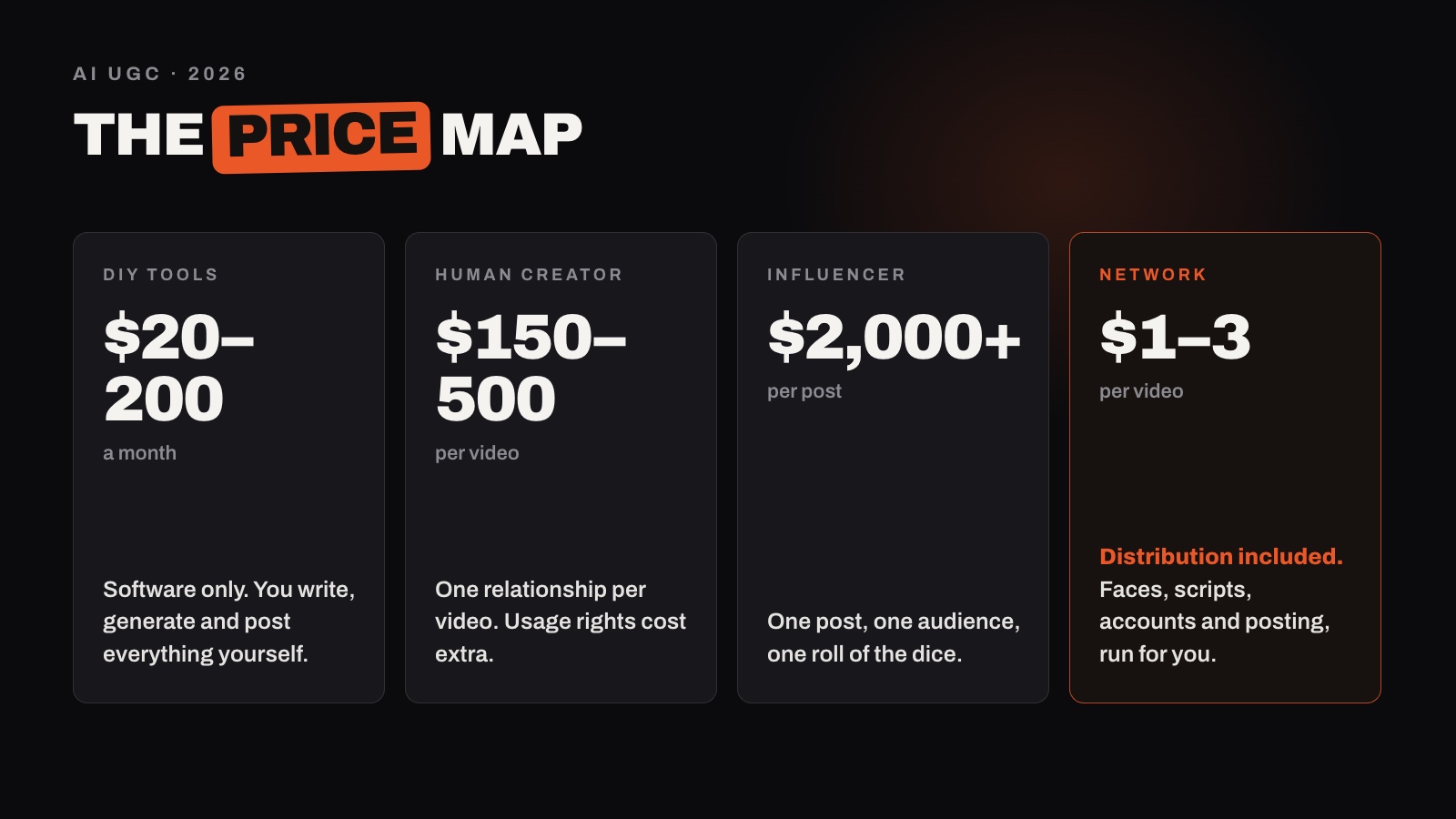
1. DIY generator tools: roughly $20 to $200 a month. A tool subscription buys you software: a library of AI faces, text-to-video, your scripts. You write, generate, download and post everything yourself. Cheap per video, but your time is the real cost, and distribution is entirely your problem.
2. A single human UGC creator: roughly $150 to $500 per video. The classic route. Rates climb with experience, and usage rights for running the video as an ad usually cost extra. Quality varies from creator to creator, and every video is one more relationship to manage. Great for five videos. Painful at fifty.
3. One influencer post: from the low thousands at going 2026 rates. Not UGC in the strict sense, but it is the budget line AI UGC usually competes against. One post, one audience, one roll of the dice, and the audience can see it is sponsored.
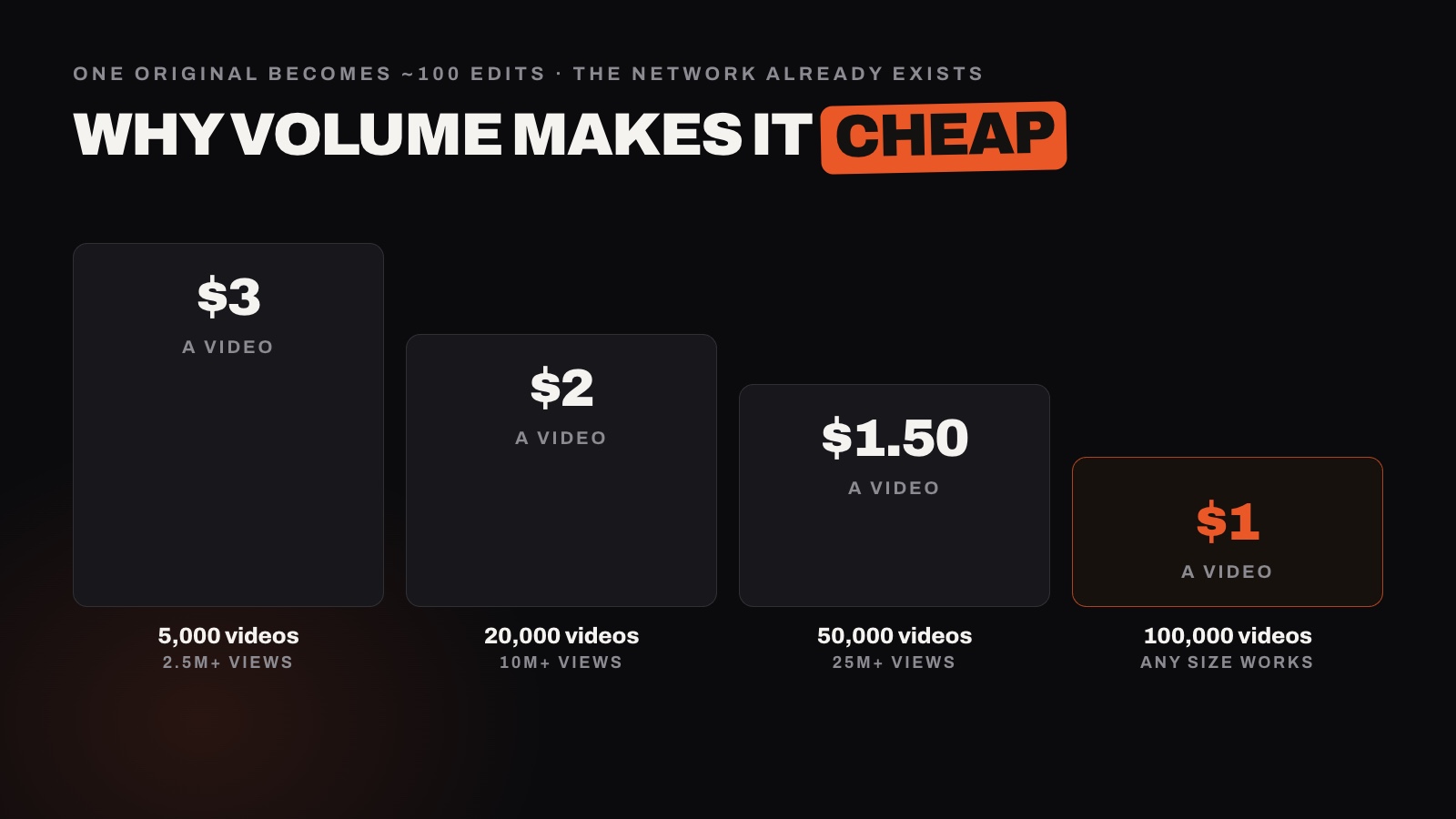
4. Full-service AI UGC at scale: $1 to $3 per video, distribution included. This is our category, so these are our numbers. The smallest package is 5,000 videos for $15,000, posted across 1,250 TikTok accounts, at $3 a video. The rate drops as volume grows: 20,000 videos at $2, 50,000 at $1.50. Any size works: at 100,000 videos the price is a dollar each. Every package includes the faces, the scripts, the accounts and the posting. You approve, we run everything else.
How can AI UGC cost $1 a video?
Nobody films 100,000 separate videos. We film hundreds of originals, and each original becomes about a hundred different edits: a new hook, new music, new captions, a different opening second. To the platform and to the person scrolling past, every edit is its own video.
The other half of the answer is that the network already exists. The accounts are real, aged and running before your campaign starts, so your budget buys videos and posting instead of infrastructure. A $1 video is an edit riding on rails that took three years to build.
AI UGC tools vs an agency: what a view costs
A video that nobody sees costs infinity per view. This is the part of the math most buyers skip.
A generator tool sells you the video and leaves the audience to you. If your own account has no reach, your $2 video gets 200 views and each view cost you a cent plus your afternoon. Our packages come with view estimates because the distribution is the product: 5,000 videos are estimated at about 2,500,000 views, and the 50,000-video flagship at about 25,000,000. Averaged out, that is roughly 500 views per video, flops included, winners on top.
So when you compare prices, compare the same thing:
- Tools sell videos. You bring the audience.
- Creators sell videos and sometimes their own audience, once.
- A network sells the audience, repeatedly, with videos included.
That is the whole tools-versus-agency choice in one line: who owns the audience your video needs.
What does a first campaign look like?
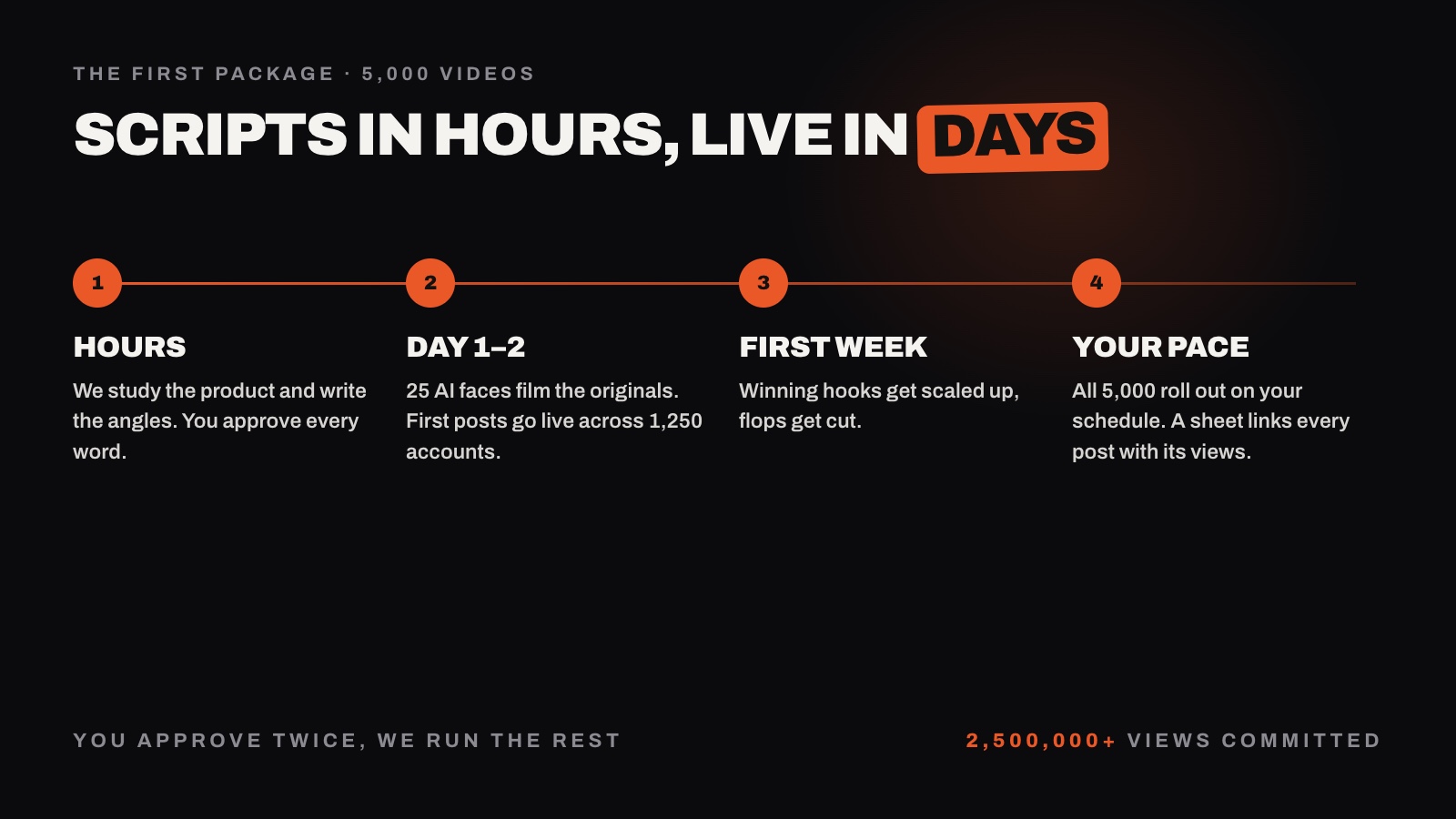
Scripts take hours, not weeks. We study your product, write the angles and send them over the same day, and you approve every word before anything is filmed. Within a day or two, 25 AI faces have filmed the originals and the first posts are live across 1,250 accounts.
From there it is tuning: hooks that pull views get scaled up, flops get cut, and the full 5,000 videos roll out at whatever pace fits your launch. The report runs alongside: a sheet with a link to every post and its numbers, so you can check every claim against TikTok itself. Two approvals, about 2,500,000 views estimated.
Does AI UGC actually work?
Our own track record, which you can hold us to: 500M+ views delivered since 2022, zero account bans across 40+ campaigns, and campaigns running in regulated niches like finance and crypto, with the brand approving every claim before it posts.
What we will not claim is that views equal sales. Views put your product in front of people again and again, from different faces, until the people who need it look it up. Whether they buy depends on your product, your price and your page. Anyone selling AI UGC as a sales guarantee is selling something else.
If you want the psychology of why many small voices out-convert one big one, we wrote about it in Why AI UGC Is More Authentic Than Influencers.
Is AI UGC legal?
Yes, with labels. TikTok requires AI-generated content to be labeled, and in our campaigns the label has not moved view counts. Viewers scroll past it like any other overlay. We label, we keep scripts inside what the client can stand behind, and every claim gets approved before anything posts. That discipline is why the ban counter above still reads zero.
Two things to check with any provider: who approves the scripts, and who carries the platform risk. If the answer to either is "you," the price should be a lot lower than what they are quoting.
FAQ
How much does one AI UGC video cost?
Between $1 and $3 from a full-service network depending on volume, $20 to $200 a month in tool subscriptions if you make it yourself, and $150 to $500 if a human creator films it. The bigger question is what a view costs: a video without distribution is a file, not an ad.
Is AI UGC the same as an AI avatar?
An AI avatar is the technology: the generated face and voice. AI UGC is the format: a creator-style product video that happens to star one. Tools sell avatars. Campaigns are made of UGC.
Do viewers know the creator is AI?
Increasingly, yes, and it matters less than people expect. The video earns attention by being watchable, not by hiding its origins. Platforms require an AI label, and creator-style ads keep beating polished ones anyway.
What are the best AI UGC tools?
Arcads (AI actors), HeyGen and Synthesia (AI avatars) and TikTok's own digital avatars are the best-known generators, at roughly $20 to $200 a month. All of them sell the video only. Distribution stays your problem, and that is the half of the cost most comparisons skip.
Can AI UGC run in regulated niches?
Yes, done carefully. Scripts stay inside what you can stand behind, claims get approved before posting, and required disclosures go in. That is why finance and crypto brands use it: the brand approves every claim before it posts.
What does $15,000 buy in AI UGC?
From us: 5,000 videos, 25 AI faces, 1,250 accounts, about 2,500,000 estimated views, everything run for you. From a tool: about six years of a top-tier subscription and a lot of your own evenings. Both are legitimate. They are just different products.
Where this goes
From where we sit, more of the feed is made this way every quarter, and the label matters less than the watchability. The brands winning with AI UGC in 2026 are the ones showing up fifty times a day, from fifty different faces, saying something true about a product worth looking up.
If you want to see what that looks like for your product, the pricing is public and the first campaign starts at $15,000. Or just tell us what you are launching and we will put a plan together.
The pricing is public, the first campaign starts at $15,000, and scripts take hours.

