Made to Look Like Real People: Where AI Ads Cross the Line
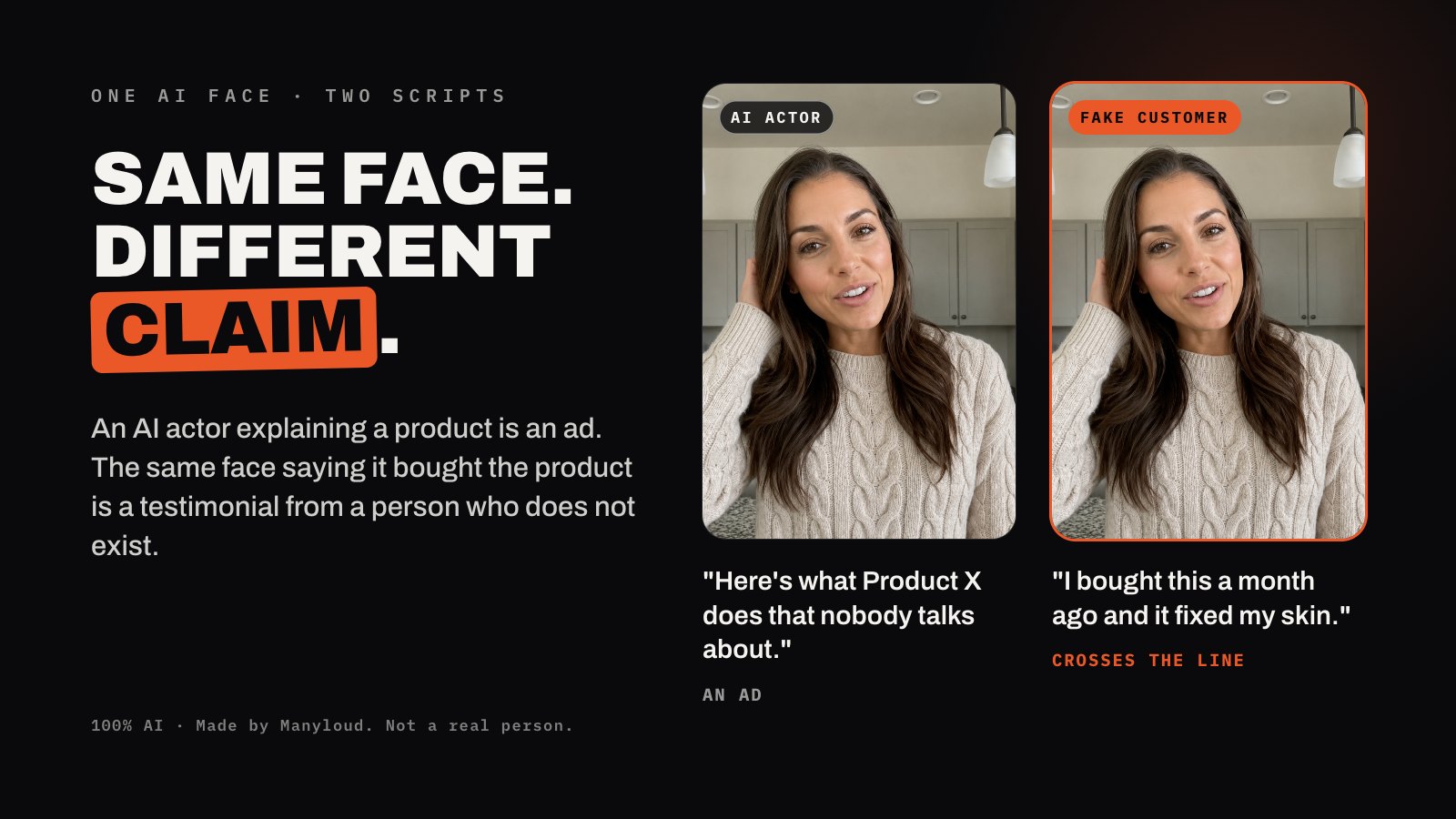
Using an AI-generated person in an ad is legal in the US, the UK and the EU. What gets a brand in trouble is the claim that person makes. An AI actor who explains a product is advertising. An AI "customer" who says they bought it, an AI "doctor" with credentials nobody issued, or a copy of a real creator crosses the line, and in 2026 each of those became a news story.
On October 30, 2026, Henrik Hoffman Kraft shared an email on LinkedIn that an agency had sent him. It offered "150+ AI avatars across TikTok & Instagram" talking about his company's product, and made this promise:
"We'll generate top, middle, and bottom of funnel niche content, carefully made to look like real people made it."
He called it "just disgusting." Manyloud makes AI creator videos for TikTok, and the same rules apply to every script we write. Below: what the law allows, three 2026 cases that broke it, and five questions to ask an agency.
Is it legal to use AI-generated people in ads?
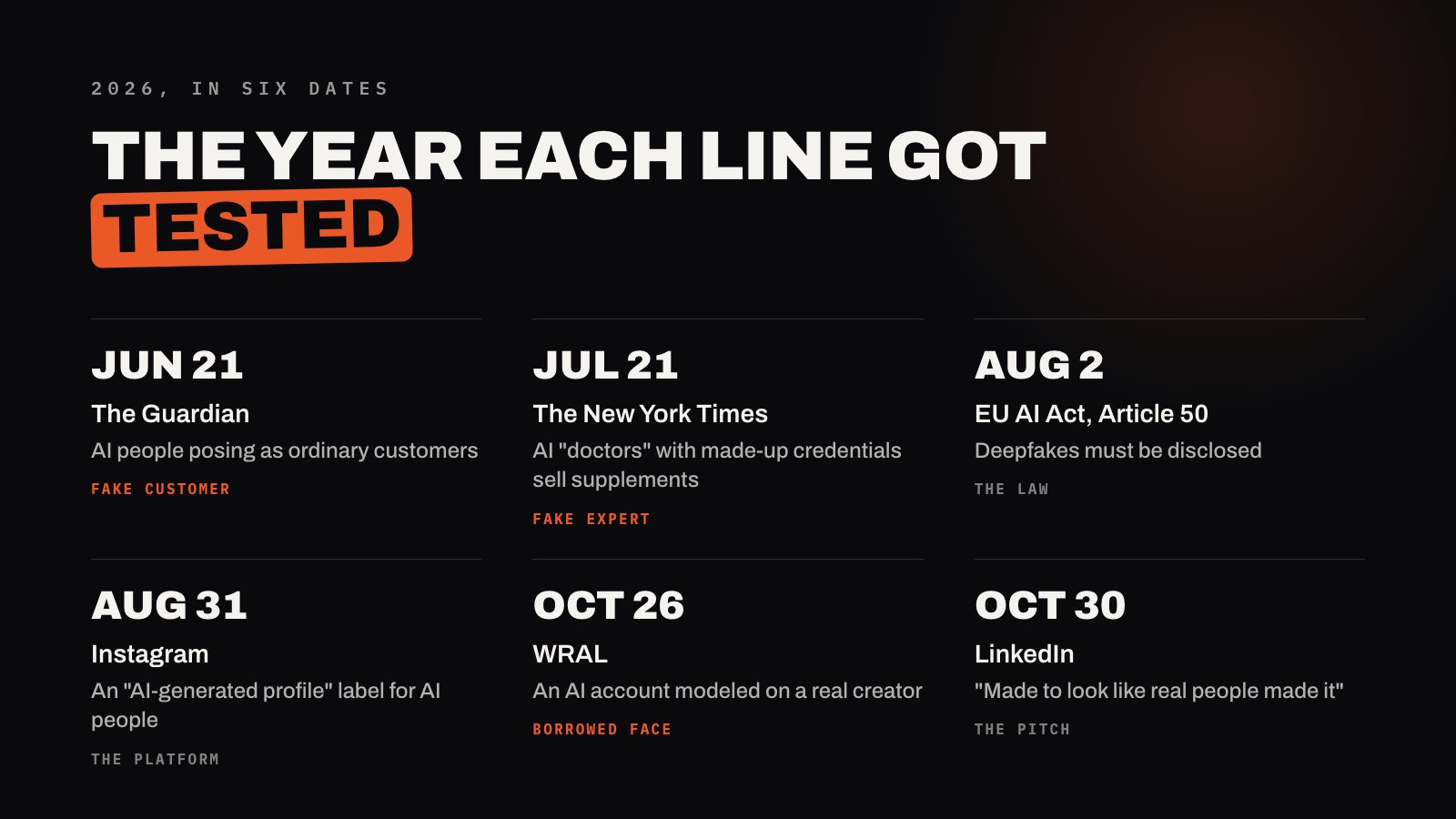
Yes. The rules treat an AI-generated person like any actor in an ad: they check whether viewers are misled about who is speaking and what that person did. The FTC's rule on reviews and testimonials, announced in August 2024 and in force since October 21, 2024, bans testimonials that misrepresent "that the reviewer or testimonialist exists," that they "used or otherwise had experience with the product," or what that experience was. In June 2026 the UK's Advertising Standards Authority told the Guardian that nothing in its rules prohibits AI content without a label, and that such an ad still "mustn't be misleading." In the EU, Article 50 of the AI Act has required since August 2, 2026 that deepfakes be disclosed: AI content that resembles an existing person, place or event and would falsely appear authentic. New York asks for more: a state law in force since June 9, 2026 requires advertisers to disclose AI-generated performers in their ads.
Where does AI marketing cross the line?
AI marketing crosses the line when an AI-generated person claims something untrue about themselves. There are three such claims. The fake customer says they bought or used the product, which the FTC rule has banned since October 2024. The fake expert appears as a doctor or another professional with credentials nobody issued, like the supplement ads the New York Times examined in July 2026. The borrowed face copies a real, identifiable creator, and in the EU that is a deepfake that has to be disclosed. An AI actor reading an ordinary ad script makes none of these claims.
Can an AI avatar pose as a customer?
No. Under the FTC rule, an AI person who says they bought or used a product is a testimonial from someone who does not exist. In June 2026, a Guardian investigation found AI content "that purports to show genuine customers." In Instagram videos that a deepfake-detection firm judged likely to be AI-generated, a crying bride thanks a photo app: "Everyone expected a no-phone wedding, so I gave them cameras instead." A person who builds AI influencers for brands told the paper that many creators sign NDAs barring them from saying AI was used, and called it "plausible deniability."
Can an AI avatar pose as a doctor?
No. A title such as "Dr." is a claim about who is speaking, and an invented one gives a health claim authority it never earned. In July 2026, the New York Times examined hundreds of ads that used AI-generated video to sell supplements. The avatars were made to look like physicians and practitioners of traditional Eastern medicine, with credentials and offices that did not exist. One ad claimed an herbal supplement treated kidney disease better than medication.
Can an AI avatar copy a real person?
No. A copy trades on someone else's face and their audience's trust, and in the EU a video that passes as a real, identifiable person has been a deepfake requiring disclosure since August 2, 2026. On October 26, 2026, WRAL reported on @MiaTriso21, an account on TikTok and Instagram whose face some viewers believed was modeled on Anya, a creator with Down syndrome who runs a family fitness account with her sister. Both platforms removed the account after WRAL asked about it, and other versions were still circulating. "These accounts borrow a real creator's body, voice, and audience trust," Laeeq Khan, who directs Ohio University's social media analytics research lab, told the station.
Does an AI label fix it?
An AI label fixes one problem: it tells viewers the person was generated. It does not make a false claim true. An AI "doctor" with a label is still not a doctor, and an AI "customer" with a label still never bought the product.
Platforms are adding labels too. TechCrunch reported on August 31, 2026 that Instagram had introduced an "AI-generated profile" label for accounts that feature an AI-generated person, and that accounts skipping it could see their reach reduced. A brand should carry every label its markets require and then apply the Advertising Standards Authority's test: does the ad mislead anyone?
What is wrong with content "made to look like real people made it"?
In October 2026 an agency emailed Henrik Hoffman Kraft offering "150+ AI avatars across TikTok & Instagram" and content "carefully made to look like real people made it." The avatar count and the funnel plan describe ordinary production. The trouble is the last promise. In videos about his company's product, it reads as an offer of customers who do not exist, and the email never says what the avatars would claim or who would approve the scripts.
What should a brand ask an AI creator agency?
Ask an agency these five questions, and get the answers written into the contract.
- Will any creator say they bought, used or were helped by my product? The answer should be no. AI actors can explain, show and compare a product without claiming to have used it.
- Will any creator carry a title, such as doctor, nurse, trader or financial adviser? The answer should be no.
- Whose faces and voices are these? Every face and voice should be original, with nothing taken from a real person.
- What do the creators' profiles say about them? A bio should not give a creator a job, a degree or a history with your product.
- Which AI labels and #ad tags go on, and who decides? Everything your markets require goes on every time, and the rest should be your call, market by market.
For questions about the accounts themselves, see seven questions to tell a bot farm from a creator network.
How does Manyloud draw the line?
Our AI creators are actors. Each one has an age, a city and an interest, and never a profession or a story of having used the product. Every face is original, with no real person's face or voice. Clients approve every script before anything posts. We never buy likes, comments, follows or messages, and we never fake reviews around a campaign. Whatever a market's rules require always goes on, and beyond that the label is the client's call, market by market. We turn away political campaigns and governments.
If you are weighing an AI creator campaign, tell us what you are launching.
The pricing is public, the first campaign starts at $15,000, and scripts take hours.